ADHD & Autism Assessment - Right To Choose
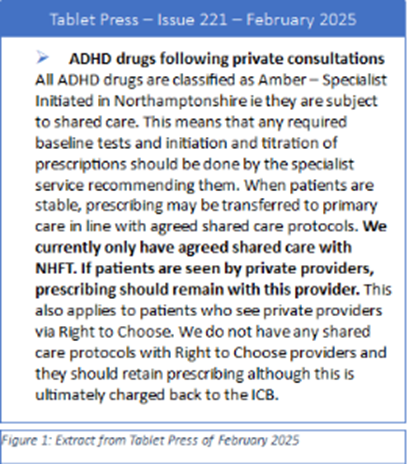
The following information is for guidance and should be carefully taken into consideration before any referral choice is made for any Autism or ADHD assessments. What should happen? 1) A patient’s GP (or School SENCO in the case of a child) should refer the patient to an NHS ADHD/Autism service where the patient will be assessed. 2) An NHS ADHD/Autism service is commissioned to assess, diagnose, (and if needed) start medication, titrate the drug to the appropriate dose and provide post-diagnostic reviews. 3) The NHS specialist will also remain responsible for arranging an annual review, which includes a review of the patient’s ADHD/Autism symptoms, medication (if needed), and a physical assessment. 4) Once an established dose of the appropriate medication has been achieved, we as GP’s may be responsible for ongoing prescribing and monitoring under a Shared Care Agreement (“SCA”) with the NHS service specialist. However, the ultimate responsibility for prescribing and monitoring remains with the specialist. 5) An Shared Care Agreement is a carefully crafted, well-established and a pre-arranged agreement with defined responsibilities for both the NHS specialist and the NHS GP. 6) An essential element of a safe SCA is that it provides the NHS GP with prompt access to a specialist in case of any concerns or problems. ------------------------------------------------------------------ So What is Right to Choose? Introduction to Right to Choose Referrals This important right allows you to explore alternative providers if the waiting time for an ADHD or ASD assessment is too long. Right to Choose, introduced in 2018, is still a relatively new system, and many patients may not be aware of these options. Who Can Offer Right to Choose Assessments? Which Providers Offer Right to Choose Assessments? Important Resources Things to Consider About Right to Choose Patients (or their parents/guardians) should exercise care when selecting Private or Right to Choose providers, significantly when investing their own time or finances, to avoid disappointment and disruption to treatment. Private providers each have their own referral process, and you should refer to their websites for more information. It’s important to note that you can not be on an NHS referral pathway waiting list as well as on the Right To Choose pathway. So if you are already on an NHS pathway assessment waiting list and choose to go through Right To Choose you must come off the NHS waiting list. Many Right To Choose providers/clinics offering these assessments can diagnose ADHD or ASD but may not provide medication titration. This means you might need a local NHS referral if medication is required to manage symptoms. You need to be aware that should you choose to be referred to a private provider and a diagnosis is made; your GP will not be able to prescribe ADHD medication or arrange monitoring. This is because the Private Providers may not be able to offer the same follow-up or monitoring as NHS specialists. Sometimes, this is because they do not provide follow-up appointments, or the patient cannot afford the ongoing private charges. Practically, this also means your GP does not enter “Shared Care” agreements with Private Providers. If you wish to proceed, it is crucial to appreciate that the Private Provider must provide you with any ADHD medication they recommend; you should check the initial and ongoing treatment costs, including prescription and yearly reviews. Northamptonshire Prescribing Policy (February 2025) The Integrated Care Board (ICB) in Northamptonshire is entitled to issue instructions concerning GP prescribing in the County, and from time to time, it does so via a monthly publication called “Tablet Press”. The February 2025 issue instructs GPs not to prescribe ADHD drugs, which private providers have recommended. The key point is that specific standards are required for “Shared Care, “which cannot be imposed unilaterally by a private provider. The counties only agreed shared care arrangement is with Northamptonshire Healthcare Foundation Trust (NHFT), the County’s mental health and community services provider. The relevant extract from the publication is shown in Figure When Can You Not Use Right to Choose? How to Request a Right to Choose Referral from Your GP What Happens After Choosing a Clinic? How Much Quicker Will Right to Choose Be? Why Choose Right to Choose If Medication May Not Be Easily Accessible? Further Questions? Information on ADHD Information on ASDRight to Choose: ASD & ADHD Assessment Pathways
In England, under the NHS, you now have a legal right to choose your mental healthcare provider, including for Autism Spectrum Disorder (ASD) and Attention Deficit Hyperactivity Disorder (ADHD) assessments. This service, offered through the NHS, is free of charge.
Did you know that NHS patients have the legal right to select their mental healthcare provider? Under NHS England’s Right to Choose arrangements, Patients (or their parents/guardians) can see an appropriate health service provider.
Several clinics across the UK offer Right to Choose ADHD and/or ASD assessments. The provider can be anywhere in England if it holds an NHS commissioned contract somewhere in England – it does not have to be in Northamptonshire.. Private-only clinics are not eligible. Checking a provider’s website is a good way to determine if they offer the services you need.
The list of clinics offering Right to Choose assessments is constantly evolving. Currently, several clinics are available, but there may be other providers worth researching as well.
There are certain restrictions on eligibility for Right to Choose referrals. You are not eligible if:
Have an open conversation with your GP about your concerns regarding ADHD or ASD. Your GP may suggest a referral for an official assessment. With waiting times for ADHD and ASD assessments in Northampton over a year plus, Right to Choose can offer faster alternatives, reducing the long wait for diagnosis and support.
Once you select a clinic, either you or your family (if the patient is a child) will need to research and decide which provider to choose. Your GP cannot advise on which clinic to select. After making your choice, email or send an admin E-consult with your selection and any relevant forms to ensure an efficient referral process. The NHS standard contract (section 7.9) dictates the use of the e-RS referral system but does not require the use of a form to accompany such a referral. Your GP will make the referral by letter but will not complete forms created by the providers.
The speed of the assessment depends on your chosen clinic and whether they offer medication titration. Generally, Right to Choose assessments can take anywhere from 12 weeks to 12 months—much quicker than the local NHS alternatives, which have waiting times of up to 7 years. If a clinic offers a diagnosis but not medication titration, you may need an additional referral for post-diagnostic support,which can take up to 24 months locally. Your GP will not initiate specialist medication and will only prescribe once the patient is stable on a dose and if the provider can meet the same standard for shared care as local NHS services.
Many patients find that a diagnosis is sufficient for obtaining additional support from schools or employers, or they may not need medication at all for managing their conditions.
If you have additional questions, a simple call to your surgery may provide answers. For further research, here are some helpful resources:
Mind: Autism and mental health
Page created: 20 January 2026